



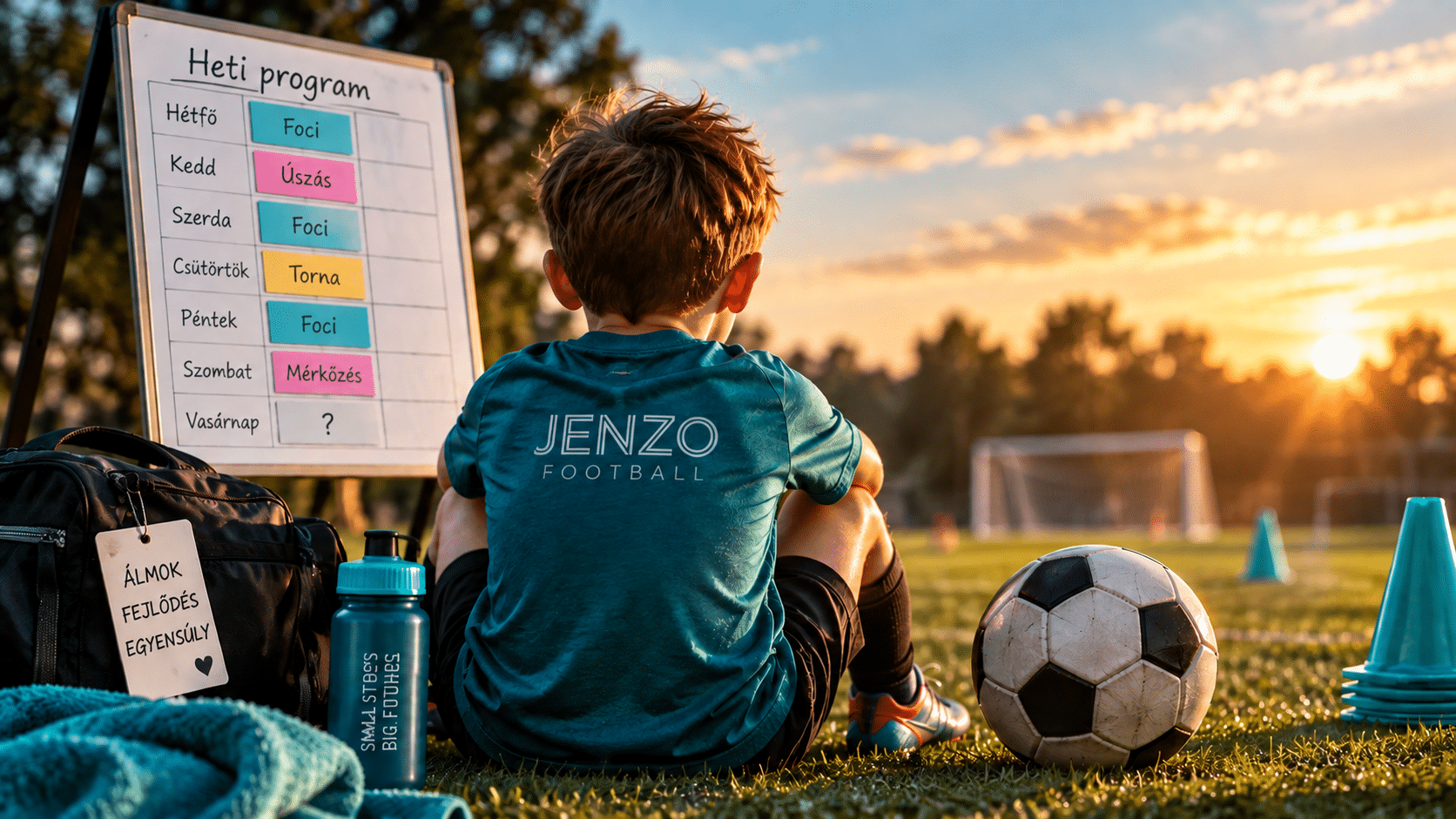
Football on Monday and Wednesday. Swimming on Tuesday. Another training session on Friday. A match at the weekend.
At first glance, we might think: how wonderful that our child is so active.
And it is true: physical activity is essential during childhood. It supports healthy physical development, helps children develop movement skills, creates opportunities for social interaction and can contribute to a lifelong love of being active.
But there is a question worth asking from time to time as parents:
Can there be too much of a good thing?
Where is the point at which physical activity stops being energising and starts becoming exhausting? When does training stop being something a child looks forward to and become just another obligation?
And how can a parent tell whether their child is simply tired after a demanding week – or whether they are genuinely being asked to do too much?
The answer cannot be found in one magic number.
There is no single answer to how much sport a child should do that applies to every age and every child.
According to the World Health Organization (WHO), children and adolescents aged 5–17 should get an average of at least 60 minutes of moderate-to-vigorous physical activity per day across the week.
Younger children need even more opportunities to move. For children aged 1–2, the recommendation is at least 180 minutes of varied physical activity throughout the day. For children aged 3–4, it is also at least 180 minutes, of which at least 60 minutes should be moderate-to-vigorous activity.
There is, however, one very important distinction:
physical activity is not the same as organised sports training.
A child is physically active when riding a bike, playing tag, running around the playground, kicking a ball with friends, walking, climbing or simply playing freely.
Not every minute of movement needs to take place in a coach-led session.
In fact, free movement and play have a particularly important place in childhood.
There is no number that works for every child.
Three training sessions per week might be exciting and energising for one child, while for another – because of school, other activities, travelling or simply their individual personality – the same schedule may already feel like too much.
Rather than simply counting the number of hours a child spends doing sport, it is worth looking at their entire week.
What time do they wake up?
How long are they at school or nursery?
How much homework do they have?
How much time do they spend travelling?
Do they attend other extracurricular activities?
When do they eat dinner?
Are they getting enough sleep?
Is there still time simply to play?
And perhaps most importantly:
Is there still time in their week when they do not have to be anywhere?
For a child, rest is not wasted time.
It is part of development.
Parents often wonder whether it is beneficial for children to participate in several different sports.
During childhood, there can be many advantages.
Different activities develop different skills. Swimming, gymnastics, athletics, ball sports, cycling or even dancing can provide very different movement experiences.
Trying different activities also gives children the opportunity to discover what they genuinely enjoy.
The American Academy of Pediatrics highlights concerns associated with high training volumes, insufficient recovery and early specialisation in a single sport. Providing children with varied sporting experiences can help support broader development and reduce some of the pressures associated with focusing exclusively on one sport too early.
But that does not mean that more sports are always better.
If football, swimming, gymnastics and tennis together mean that a child has an organised training session every single day of the week, the activities may be varied – but the child’s body and mind may still have too little time to recover.
It is not necessarily the number of different sports that matters.
It is the total load placed on the child.
Even as adults, we sometimes forget this.
The body does not develop only while training.
It also needs recovery, appropriate nutrition and sufficient sleep.
The American Academy of Pediatrics emphasises the importance of balancing training load with adequate recovery in young athletes and recommends regular time away from sport-specific training.
That does not mean children need to spend their rest periods sitting still.
They can ride their bikes, swim, go hiking, try another activity or simply play.
The important thing is that there is time to step away – both physically and mentally – from the constant demands of structured training and performance.
Overload is not always obvious.
It does not necessarily begin with a child suddenly declaring:
“I don’t want to play sport anymore.”
The first signs can be much more subtle.
Perhaps getting up in the morning becomes harder.
They say they are tired more often.
They become more irritable.
They find it harder to concentrate.
They start complaining about aches and pains more frequently.
They become less enthusiastic about training.
Or perhaps the child who once stood at the door with their sports bag ready before the parent had even found the car keys suddenly starts negotiating:
“Do I have to go today?”
One occasion like this is not necessarily a problem.
We all have days when we do not feel like doing something.
Children do too.
The more important question is whether it is an occasional feeling or a lasting change.
There is a big difference between the two.
A child may simply be tired after a long day at school. They may be in a bad mood. They may have fallen out with a friend. Or perhaps they would simply rather stay home and play that afternoon.
That is completely normal.
It is worth paying closer attention, however, when a child begins to lose enthusiasm for a sport they previously loved – and that change continues for weeks.
Possible signs of overload or burnout related to sport may include:
The AAP notes that imbalances between training and recovery can contribute to overuse injuries, overtraining, reduced well-being, loss of enjoyment and burnout in young athletes.
Of course, one of these signs alone does not mean that a child is experiencing burnout. Tiredness, pain, mood changes or declining performance can have many different causes.
But when several signs appear together and persist over time, they are worth taking seriously.
It may be appropriate to reduce the training load, talk to the child and their coach, and, when necessary, seek advice from a paediatrician or another appropriately qualified professional.
Not:
“Were you good today?”
And not necessarily:
“Did you win?”
Instead, try:
“Did you enjoy it?”
The answer can tell us a great deal.
Especially when we do not ask only once, but continue listening over time.
Because one of the most important purposes of sport during childhood is not to maximise results.
It is to help create a relationship with movement that may stay with a child for the rest of their life.
Every now and then, it can be useful to think about a few simple questions:
Does my child still look forward to training?
Do they talk about what happened there without being prompted?
Do they still have energy to play outside training?
Are they getting enough good-quality sleep?
Do they have at least one day when there is no organised sports programme?
Is there still time for friends and free play?
Do they frequently complain about pain or tiredness?
Have they become more anxious before training or matches?
Do they still want to continue this sport?
And there is one more question that may be the hardest of all:
If they told us tomorrow that they wanted to do a little less sport, could we really listen without making them feel that we were disappointed?
Most parents want the best for their children.
We drive them to training.
We buy the equipment.
We wake up early at weekends.
We stand beside the pitch.
We celebrate their successes.
And when we see that our child has talent, it is perfectly natural to want to give them every possible opportunity.
But there can be a very fine line between support and expectation.
Over time, a child may begin to feel that they are no longer playing only for themselves, but also to satisfy their parents or their coach.
That is why their own voice needs to be part of decisions about sport.
Sport should be something the child does – not something that is done to the child.
Perhaps this is where things become most difficult.
When a child is talented, develops quickly and is recognised by coaches as having potential, a thought can easily appear:
“What if this is the time when we need to give it everything?”
But childhood development is not a sprint.
And more training does not automatically mean more development.
Development requires the right stimulus – but it also requires recovery, motivation, a safe environment and time.
A child’s long-term development matters more than achieving a particular result a few months earlier.
Quite the opposite.
We want children to move.
To run.
To kick a ball.
To climb.
To swim.
To ride their bikes.
To try new sports.
To get muddy, become tired, laugh and discover what their bodies are capable of.
But at the same time, they need time simply to be children.
Not every form of movement needs to become a training session.
Not every afternoon needs to be scheduled.
And not every talent needs to be developed as quickly as possible.
We do not want to turn every child into a footballer.
For us, football is much more than that.
It can be a tool for building confidence, developing courage, creating friendships, nurturing a love of movement and allowing children to experience, again and again:
I can do this.
That is why we do not only pay attention to how a child performs during training.
We also care about how they arrive.
And perhaps even more importantly, how they leave.
If there is one thought worth taking away from this article, perhaps it is this:
The ideal amount of sport for a child is not necessarily the maximum amount they are capable of doing.
It is the amount that still leaves them wanting to move again tomorrow.
Because perhaps one of the greatest measures of success is not how many training sessions we managed to fit into their childhood.
It is whether, as adults, they still put on their trainers with a smile.